The Benefit of Two-Way Matching: Rooms Can Coexist
Two-way matchingProfilesRooms
1. The True Meaning of Two-Way Matching
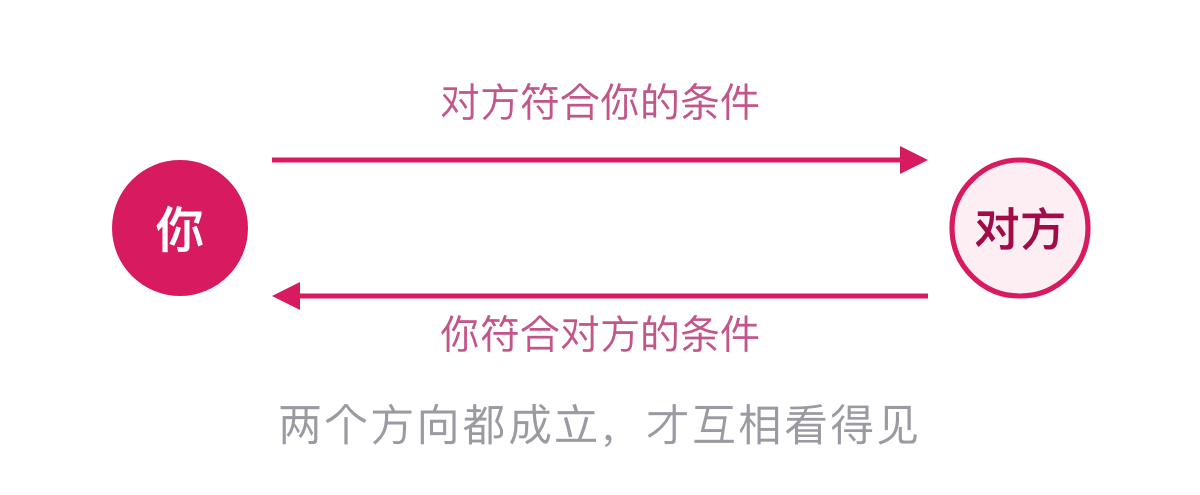
“Two-way” is a word the previous two articles never fully unpacked. It isn't a slogan — it's two directions holding at the same time.
First direction: only people who meet my criteria can see me. My profile is open only to those who pass this filter — my information stays private, and I am not disturbed.
Second direction: everyone I can see is someone whose criteria I meet. They have accepted me; people who don't meet my criteria — or aren't interested in me — are never pushed to me in the first place. I don't waste time, and I don't waste effort.
Not disturbed by people you don't want to see, and no time spent on dead ends — that is the true meaning of two-way matching.
2. Vertical Markets Are Just Two Rooms
With both directions clear, there's another benefit — two-way matching grows rooms by itself.
One-way feeds have one big pool. Two-way matching lets different people stay in their own rooms.
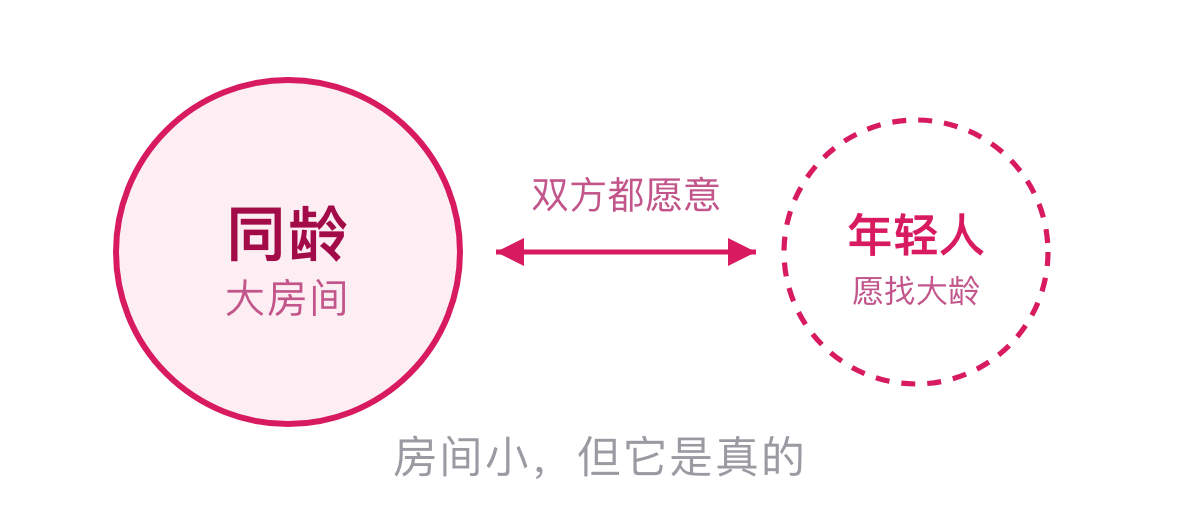
Some dating apps turn matchmaking into a vertical market: one serves only older singles, another only the divorced (the “second marriage” market). Nothing wrong with that — except one room has become the whole building.
On OnlyYou, these are simply two rooms. They can exist at the same time without interfering, and there's no need to run two separate apps.
If you're older and set the age you're looking for to “similar age”, that line itself draws the room: the people who can see you, and whom you can see, are almost all within that age range. The room for older singles grows by itself — the platform doesn't have to restrict itself to them.
If you're divorced and set the one you're looking for to “divorced”, the divorced room grows the same way — the platform doesn't have to restrict itself to divorce either.
The rooms “similar age”, “divorced” and “just dating” all run on the same platform, each on its own, without disturbing one another. Those coming to marry, and those who simply want a serious relationship, each find a room of their own.
On OnlyYou the criteria are set by users, and the rooms are drawn by you.
Apps that only serve a vertical market sort the categories for you.

3. Inside the Big Rooms, There Are Smaller Ones
But you can also step outside your room. Older singles don't necessarily want someone their own age — you can widen the age range and look for younger people.
Whether it works isn't up to you alone — it only happens if the other side also accepts older people. So beyond the big “older singles” room you can still have a small one: because something about you moved them, some younger people are willing to match with you. The room is small, but it's real.
The same applies if you're divorced. You can look for someone never married, and you won't disturb people who never married — only never-married users who accept a divorced partner will match with you.
And this kind of small room is something a vertical product simply cannot offer. If the whole building is older singles, an older single has no way to meet younger people.
You draw your line, and the other person draws theirs toward you — only then does the room exist.
4. Item by Item, You Define the Room You Enter
You write these criteria into a “matching profile”. A profile lets you set:
📌 What a profile can set
Planned residence · Sex · Age · Height · Education · Monthly income · Assets · Has photo
ID / Age / Education / Income / Asset / Top-school / Public-sector verification
Marital status (never married / divorced / widowed)
Children (none / living with me / living with them / already independent)
Two items deserve a special mention: top-school verification covers 985, 211 and QS500 — overseas institutions included; and planned residence can be set anywhere in the world — “Europe” as a whole, down to a specific country like France, or only people planning to live in the United States.
Every item can be set to “no preference” or “must have” — verification items are on/off switches; age, height, education, income and assets can be capped on one side; marital status and children allow multiple choices. The more items you mark “must have”, the higher the walls of your room.
Set everything to “no preference” and the room is at its largest — you've dropped your own requirements. But the other person still has theirs; the people who come in are still those whose requirements you meet.
Compromise on nothing and the room is at its smallest — age, education, income, marital status: every line has to line up.
An 18-year-old can be serious too. Maybe they just want a real relationship and aren't in a hurry to marry. That's not a contradiction — being serious is an attitude, not a wedding date.
Of course, people who come in also have to meet their own requirements. Your criteria decide which room you want to enter; their criteria decide whether they let you in.
A profile is a room you define yourself. Which room you enter is up to you.
5. Want to Step Out? Draw Another Profile
If your main profile boxes you in — say it says “similar age” but you'd also be open to someone a few years younger — don't change it, just create another one.
One person can have several profiles: the main one might be “similar age, never married”; the second can widen the age range, drop the marital requirement, but add other requirements — a higher degree, a top-school graduate, or clear expectations on income and assets.
Free users can create 2 profiles; VIP members more (4 to 16 depending on tier). Each profile matches on its own, without interfering with the others.
A profile isn't a label stuck on you — it's a picture of the person you want to meet.
6. Not Many People, but Every One of Them Fits
Two-way matching has an inevitable result: far fewer people will match with you. The clearer your requirements, the fewer they are — because both directions have to hold.
That's why we built match first, pay later: set your criteria and browse your matches for free, and only unlock chat once you're sure it's right.
This is also what multiple profiles are for: one profile, one room — if a room is quiet, open another one and try.
Which gives you two typical ways to use it. One is refusing to settle: this is exactly who I want, so I'll wait — matching costs nothing, so waiting is free. The other is experimenting: loosen some of your criteria, keep only the few that matter most, and see whether you meet someone excellent in another way, someone you hadn't considered.
The first one, other platforms can't do. To make their numbers look good, they offer far fewer criteria to set; here you can set a dozen-plus items one by one — open them up or lock them down.
You won't match with many people, but every match is precise — because you meet their criteria too.
7. In Closing
The easiest mistake a dating platform can make is deciding for you which “type” you belong to. Older, divorced, never married, public-sector, returnee… labels are convenient, but people are not labels.
We don't sort people into categories; we let you write down your own criteria. When the criteria are two-way, rooms grow by themselves — and there can be many of them.

Live Worldwide, on Every Platform
Android · Major Android stores, or download and install it yourself
iOS · Install the Web App, with push notifications supported
HarmonyOS · HarmonyOS AppGallery
PC · Open the website in a browser, or install the Web App